Instrumentl surveyed over 1,000 nonprofits to measure the “invisible labor” prevalent in grant work. This report quantifies, for the first time, how much organizations lose to fractured grant systems.
TOPIC
AUDIENCE

In March 2026, Instrumentl surveyed over 1,000 grant professionals to answer a question that has never been measured at scale: how much of the grant lifecycle is actually handled outside of formal systems?
We call this invisible layer of work shadow work — the manual labor that fills the gaps between the systems organizations provide and the work grant professionals are expected to do. Personal spreadsheets for tracking budgets. Email threads as systems of record. Calendar reminders for funder deadlines. Institutional knowledge that lives in one person's memory.
The findings are striking. The typical grant professional loses nearly 30 hours per week to shadow work. 87% of organizations have left funding on the table because operational burden exceeded capacity. And 89% have experienced at least one operational incident — a missed deadline, a budget discrepancy, a loss of institutional knowledge — in the past two years.
But this report isn't just about the problem. We also asked grant professionals what a better future looks like — where they'd spend reclaimed time, what should and shouldn't be automated, and what the field's leading practitioners say needs to change. Their answers point to a sector that's ready for better infrastructure, not just more effort.
This report is designed as both a benchmark and a call to action for nonprofit leaders, grants managers, CFOs, and executive directors.
Use the findings to:
Grant professionals today are expected to do more with less, and the data confirms it. 80% say their workload has grown in the past two years, with 46% saying it's increased significantly. 60% regularly work outside normal hours just to keep up.
The strain isn't just about volume — it's about the nature of the work. 65% say they spend as much time managing grant processes as doing strategic work. 71% worry about making a mistake that could jeopardize their funding. And 52% feel the complexity of what they do is invisible to their leadership.
Leading practitioners see a broader shift underway — one where the role of the grants professional is being redefined.
"Grant writers are evaluated on the number of proposals they put in and never missing a deadline — not on the quality of those proposals or the strength of programming. But it's only been in the last couple of years that I've heard grant writers consistently say, 'I'm doing strategy.' That's a real shift — redefining the work from grant writer to grant professional." — Federal Grant Consultant and Trainer, Jezreel Consulting / Federal Grants Accelerator
"When everything is treated as urgent, it leads to burnout. Start with a task audit — list all your weekly activities and prioritize them based on time investment and importance. Then, layer on the outcomes tied to your role: What were you hired to do? You can use this to guide your own decision making — or to get buy-in from leadership for more time or resources." — Rachel Werner, Principal, MyFedTrainer

The tools most grant teams rely on were never designed for grant management. 86% use spreadsheets. 84% use word processing documents. 82% use email and calendar reminders. These aren't supplementary — they're load-bearing.
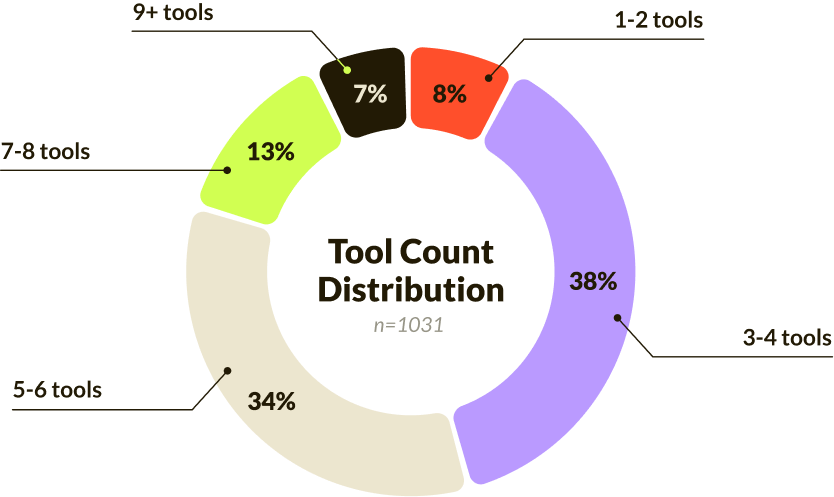
Behind the official toolstack sits a second, informal layer that actually holds operations together.
These are not edge cases. These are the default operating conditions for the sector. The personal spreadsheet isn't a stopgap — it's load-bearing infrastructure. And when the person who maintains it leaves, the system goes with them.
Experienced practitioners see two problems underneath the data: the first is structural, the second is foundational.
"Using email as a record system, tracking deadlines in personal spreadsheets, storing institutional knowledge in one person's head — are not bad habits. They are rational adaptations to broken infrastructure. People build workarounds when the systems they need don't exist." — Matt Watkins, CEO and Principal Consultant, Watkins Public Affairs
"People think it's just the tools — that software will somehow save them. It won't. To me, this is training. This is training to understand how to be a good project manager. But if you're not keeping a good, clean system, and a great folder structure, it's not a tool problem — it's a project management training problem." — Meredith Noble, Co-Founder, The Grant Writers Collective
The data suggests both are true. Fixing shadow work will take smarter systems and stronger project management fundamentals.
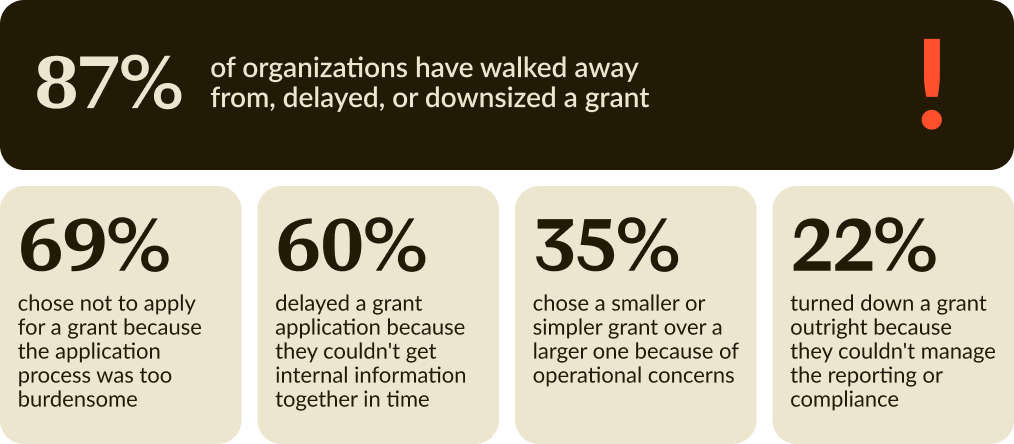
Shadow work doesn't just consume time. It directly suppresses revenue. 87% of organizations have walked away from, delayed, or downsized a grant because of operational burden. Among them:
The median grant walked away from was worth an estimated $75,000. A third were valued at $100,000 or more. 63 respondents reported leaving $500K+ on the table.
Meanwhile, 89% have experienced at least one operational incident in the past two years — a missed reporting deadline, a budget discrepancy discovered after a funder deadline, an application submitted with errors. The average respondent has experienced 2.8 of these incidents. And the confidence gap is real: only 18% can answer a basic budget question within minutes. Most organizations were never set up to track spending at the grant level in the first place.
"The sector tends to frame this as an efficiency issue, but it's a capital access issue. Organizations are self-selecting out of competitive funding not because they lack mission alignment but because the operational burden of applying exceeds their internal capacity." — Matt Watkins, CEO and Principal Consultant, Watkins Public Affairs
We asked respondents: "If you could wave a magic wand and fix one thing about how your organization manages grants, what would it be?"
The top five responses — accounting for 60% of all answers — map to a clear pattern:
The first two are infrastructure problems. The next two are coordination problems. The fifth is a recognition problem. Grant professionals aren't asking for magic — they want systems that reduce the manual overhead of managing information across people and tools.
When asked where reclaimed hours would go, the top answer wasn't catching up on admin. It was building stronger funder relationships (51%), followed by strategic planning (35%) and pursuing larger or more complex grants (33%).
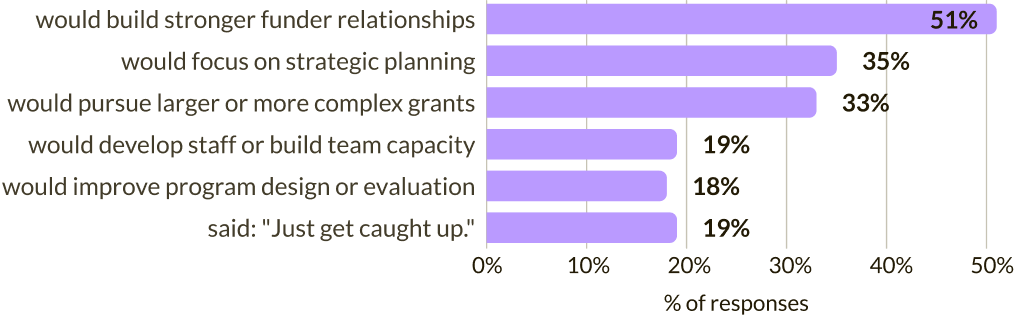
"A huge role of grant writers that most people don't realize is actual program development — creating programs, scaling programs, creating pilot programs. But we're so overburdened trying to find the grants in the first place. If you can free up some of that time, it could go into strategic work."— Tonia Brown-Kinzel, Grant Compliance Manager, The Grant Plant, Inc.
We asked every expert the same question: what should be automated, and what should never be?
The consensus was clear. Automate the reformatting, the funder research, the deadline tracking, and the first drafts of routine narrative content. Never automate strategic decision-making about which grants to pursue, program design and development, funder relationship cultivation, or final quality review.
The full report includes the complete framework from all six experts — but the through-line is consistent: technology should handle the coordination burden so grant professionals can do the work that actually requires their judgment.
"The strategic work — logic models, partner identification, program development — that cannot be automated. That requires significant human involvement and experience. That's where our expertise lives, and that's where grant professionals should be spending their time." — Shavonn Richardson, Founder and CEO, Think + Ink Grant Consulting
"AI isn't this huge time saver like everyone thinks it is. But what it does is reduce cognitive load for admin tasks — it makes the weight of what we show up to do a little bit lighter, so you can free up more creative juice for the work that actually matters." — Meredith Noble, Co-Founder, The Grant Writers Collective
The data in this report makes something visible that grant professionals have felt for years: the systems weren't built for this work, and the cost of that gap is measured in missed funding, burned-out staff, and organizations that can't pursue the opportunities their missions deserve.
Instrumentl brings your entire grant lifecycle into one place — so you can stop stitching together spreadsheets and start focusing on strategy.
This report is based on a survey of 1,031 grant professionals conducted in March 2026. Respondents represented a mix of organization sizes, budgets, grant volumes, and roles. The survey included both structured questions (Likert scales, categorical ranges, multi-select) and open-text responses.
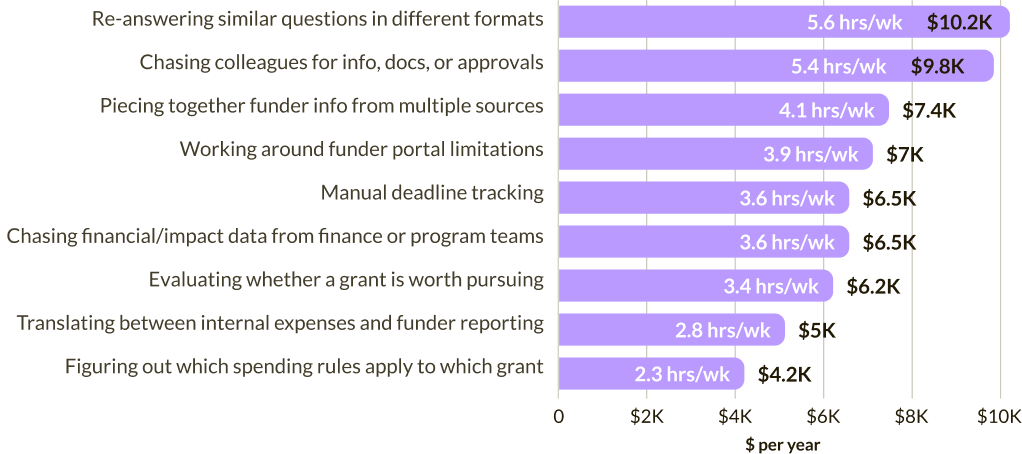
Headline time and cost figures use median values across respondents who answered all nine time-estimation questions (n=756), with midpoint estimates from categorical ranges. This approach was chosen to be conservative and defensible. Individual activity medians sum higher than the per-person total because not every respondent spends time on every category.
The report also includes perspectives from six leading grant practitioners — Rachel Werner, Fielding Jezreel, Shavonn Richardson, Meredith Noble, Matt Watkins, and Tonia Brown-Kinzel — interviewed independently, whose commentary is woven throughout the findings.
This was a non-probability survey, designed to provide a sector-wide snapshot rather than a statistically representative sample. Results should be understood as directional benchmarks — patterns and challenges that are widely shared, but not generalizable to every organization.
Table of contents

