This guide breaks down how nonprofit grant teams can create a disciplined, stage-based system. It covers how to qualify and score opportunities before committing staff time, which pipeline metrics actually signal program health, and when dedicated tracking tools outperform spreadsheets — with a practical framework for managing 20+ active opportunities.
TOPIC
AUDIENCE
Organizations rarely manage just one or two grant opportunities at a time. As grant portfolios grow, many nonprofits find themselves tracking deadlines, proposal tasks, reporting requirements, and funder communications across a CRM, spreadsheets, email threads, and scattered notes. What may work for a small number of applications quickly becomes difficult to sustain as teams manage dozens of grant funding opportunities simultaneously.
The organizations that consistently build strong grant programs often have one thing in common: clear operational systems behind the scenes. They know which opportunities are worth pursuing, where each application stands in the process, who owns specific tasks, and which deadlines are approaching.
That operational system is called grant pipeline management.
Grant pipeline management is the structured process of tracking grant opportunities through defined stages of the application process, from grant prospect research and qualification to submission and grant management.
In this guide, we’ll cover how grant pipeline management works, why it matters, and how it strengthens overall grant strategy by helping nonprofits stay organized, focused, and proactive through the entire grant lifecycle.
Every grant opportunity moves through the same arc, from identification to final decision. The organizations that manage that arc well break it into six distinct stages, each with its own information requirements and exit criteria. Without that structure, opportunities stall, deadlines become reactive, and the team loses visibility into which grants are worth pursuing.
An opportunity gets flagged as potentially relevant through a funder alert, a colleague's recommendation, a grant database, or a matching tool. At this stage, you typically know:
No detailed vetting has happened yet. In this stage, the goal is to identify and collect potential nonprofit grant opportunities before determining whether they are worth pursuing. Many organizations intentionally source a diverse portfolio of grants (state, corporate, foundation, federal) to build a balanced and sustainable pipeline.
By Stage 2, the opportunity has been vetted more closely for alignment, eligibility, competitiveness, and funding history. The team is gathering enough information to make a preliminary go/no-go call before any proposal work begins.
During this phase, teams should evaluate:
For a deeper walk-through of how to vet funders well, see: How to Do Grant Prospect Research.
By Stage 3, the opportunity has passed the organization’s internal qualification criteria and is approved for pursuit. Eligibility has been confirmed, organizational readiness has been assessed, and the team has evaluated both alignment and internal capacity at this point.
This is the stage that many organizations skip, moving directly from “we found a grant” to “we’re writing it.” The result is bloated pipelines, rushed applications, and lower win rates across the board.
Before moving an opportunity into active development, it's worth confirming that your organization is actually ready to take it on. For a checklist to work through, see: The Grant Readiness Checklist.
By Stage 4, the opportunity has moved from evaluation to execution. Active proposal development is underway, with assigned ownership, internal deadlines, and a working draft moving through review. Teams should have a clear proposal workflow with milestones for:
Hitting those milestones consistently requires building a structured grant timeline early in the process to help prevent last-minute bottlenecks and keep grant applications moving toward submission.
At Stage 5, the application has been submitted, but the opportunity remains active within the pipeline. Submitted grants still require oversight and follow-through until a funder decision comes back.
Teams should continue tracking:
Here, the opportunity reaches its final outcome, and the pipeline's job shifts. Awarded grants hand off to post-award management. Declined grants feed information back into your qualification criteria for next time.
Awarded grants transition into broader grant management processes, including:
Declined opportunities should also be carefully documented, including any feedback or recurring decline patterns that can strengthen future proposals. Every declined grant provides important operational data that can improve future grant performance.
Without a consistent scoring system, grant pipelines quickly become reactive as teams chase whichever RFP feels most urgent rather than focusing on opportunities with strong alignment, realistic competitiveness, and manageable workloads - ultimately overloading staff, reducing proposal quality, and contributing to burnout.
A simple 1–5 scoring scale across four core categories gives grant teams a consistent way to evaluate opportunities before moving them into active development.
How closely does the opportunity align with the organization’s existing programs, priorities, and the populations it serves?
Opportunities with weak alignment often require excessive customization, which increases staff workload and lowers proposal quality.
How likely is the organization to realistically secure the funding opportunity?
How much internal staff time and operational effort will the application require relative to the current workload?
Some proposals may appear attractive financially but require significant staff time, complex compliance requirements, extensive attachments, or coordination across multiple partners and departments.
Organizations that consistently evaluate workload demands alongside funding potential are often better positioned to maintain proposal quality and avoid staff burnout.
Some grants provide value beyond the award amount itself by strengthening funder relationships, supporting long-term strategic goals, or helping diversify nonprofit funding across multiple revenue streams.
Teams often score opportunities higher when they align with the organization’s broader annual funding plan and long-term fundraising priorities.
Add the four scores together for a total between 4 and 20. That total tells you how to prioritize the opportunity against everything else in the pipeline:
Below 8: Decline. Low-scoring opportunities frequently create unnecessary workload strain with a limited ROI.
8-11: Pursue only if low effort. Trade-offs across alignment, competitiveness, and capacity rarely justify a significant time investment at this range.
12-15: Pursue if capacity allows. These grants may be worth pursuing, but teams should elevate current proposal volume and staff bandwidth before moving forward.
16-20: Pursue aggressively. These opportunities demonstrate strong alignment, realistic competitiveness, manageable workload demands, and meaningful strategic value.
Pro Tip: Run your score once when you first find the opportunity, and again after your team has looked at the full RFP. Alignment and capacity scores often shift once the actual requirements are clear, and that second pass can save you from committing to a proposal that looked better on paper.
A grant pipeline is only useful if teams can measure whether it is actually working. Without operational metrics, it becomes difficult to identify bottlenecks, forecast workload, or understand why certain opportunities consistently move forward while others stall out. Six core metrics give grant teams visibility into pipeline performance, capacity, and long-term funding trends.
Pipeline value measures the total projected dollar amount of all active opportunities currently moving through the pipeline. Many organizations break this down further by stage, funder type, or estimated probability of success.
Tracking pipeline value helps teams forecast potential revenue and identify whether too much funding is concentrated in a single grant, funder category, or deadline period.
Grant win rate measures the percentage of submitted applications that ultimately receive funding. Organizations that consistently track historical grant win rates are often better positioned to evaluate whether their qualification criteria and prioritization systems are actually working.
Low win rates can sometimes indicate:
High win rates, on the other hand, often reflect disciplined opportunity selection and stronger alignment between funder priorities and organizational programs.
Pipeline velocity measures how quickly opportunities move through each stage of the pipeline. When grants regularly sit in “Researched” or “In Progress” for weeks at a time, that may indicate unclear ownership, overloaded staff, or proposal bottlenecks.
Slow-moving pipelines often create deadline compression later in the process, increasing stress and reducing proposal quality.
Pro Tip: If you track nothing else, track stage velocity for your "In Progress" opportunities. When proposals regularly sit in draft for more than two weeks without an update, that's usually an ownership problem. One weekly check-in that asks "who's moving this forward?" is often more useful than a new tool.
Stage conversion rates track how many opportunities successfully move from one stage to the next:
These ratios reveal where the pipeline leaks. A low Identified → Researched rate suggests the research stage is filtering too aggressively. A low Submitted → Awarded rate suggests qualification standards need tightening, or proposal quality is suffering from capacity strain.
Deadline concentration measures how many applications are due within the same timeframe. For example, having 8 proposals due within 30 days may create significant review bottlenecks and staff overload, even if the total pipeline size appears manageable on paper. Tracking deadline clustering helps teams redistribute workload and avoid last-minute proposal compression.
Capacity load tracks how many active proposals each team member is managing at a given time. This metric becomes especially important for small grant teams where one writer or grants manager may unintentionally become the bottleneck for the entire pipeline.
Most grant writers can sustainably manage three to four active proposals before quality starts to slip. Tracking capacity load against that threshold helps protect proposal quality and reduce burnout during high-volume submission periods.
Most grant teams start with a spreadsheet. For smaller organizations managing a limited number of opportunities, spreadsheets can be an effective and affordable way to track deadlines, proposal status, and funder information. The real question is whether they continue to work as the pipeline grows.
Spreadsheets are often effective when:
For small or early-stage nonprofit grant programs, a structured grant-tracking spreadsheet can provide sufficient visibility to manage deadlines and proposal statuses effectively.
Spreadsheets can become more difficult to manage when organizations juggle 15–25 active opportunities across multiple funders, deadlines, and team members. Common operational issues include:
These problems hit hardest during busy submission periods, when several proposals come due within the same 30–60 day window.
For a structured approach to managing deadlines at that volume, see: How to Build a Grant Calendar.
Dedicated grant tracking platforms are designed to support larger, more operationally complex pipelines. Instead of manually updating spreadsheets, teams can manage opportunities, deadlines, proposal stages, and task ownership within one centralized system.
Instrumentl’s grant tracker is built specifically for this workflow. Teams can:
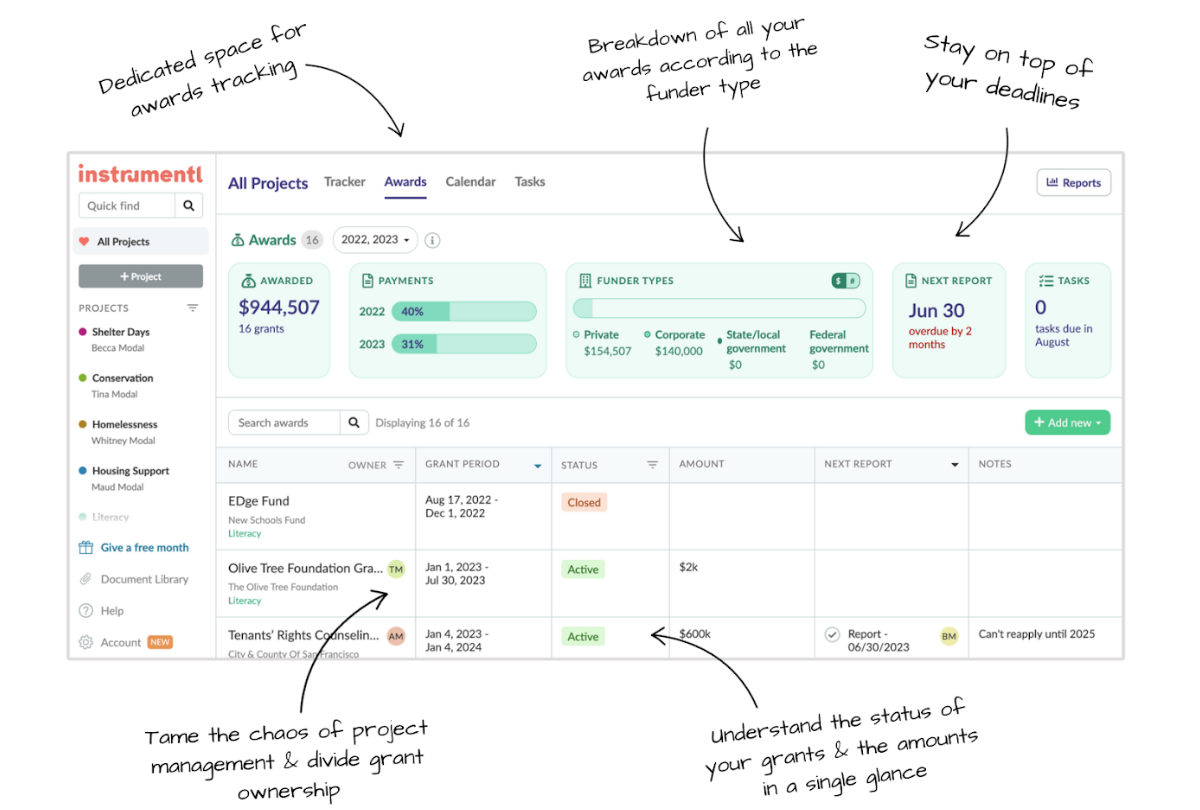
Unlike spreadsheets, dedicated platforms also cut down on manual administrative work. Instrumentl's grant database is monitored and updated by in-house grant experts, so opportunity details stay current without manual entry, and deadline reminders fire automatically.
➡ Try Instrumentl's grant tracker free
For a broader view of how pipeline management connects to long-term fundraising planning, see: Creating Winning Grant Strategies.
Managing 20+ active opportunities is an operational and project management challenge, not a writing one. When a team is juggling 9 deadlines in the next 45 days, memory and email threads stop being enough. The organizations that submit strong proposals consistently are the ones with repeatable systems for tracking movement, managing capacity, and catching risks early.
Most pipeline breakdowns are preventable. The six practices below address where high-volume pipelines most often go wrong.
Block 30 minutes every Monday to review every active opportunity:
This single habit can prevent more missed deadlines than any tool.
A tool like Instrumentl’s grant tracker can support this workflow by keeping opportunity stages, deadlines, task ownership, and funder details in one shared place.
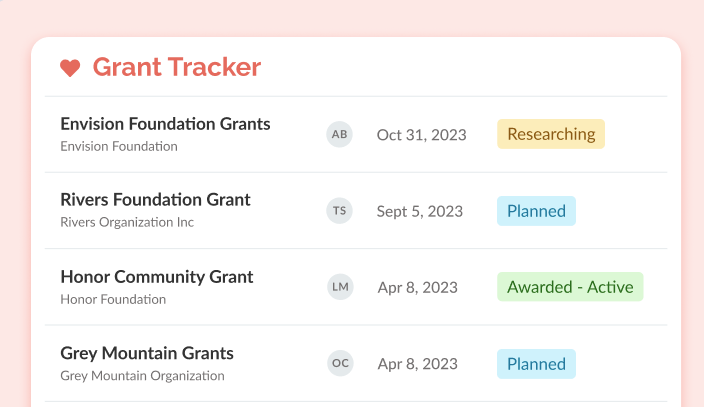
This ensures the weekly review is based on current pipeline information rather than scattered notes or outdated spreadsheet tabs.
Never use the actual funder deadline as your working deadline. Set internal deadlines:
In high-volume pipelines, something will almost always go wrong: budgets arrive late, attachments are missing, or submission portals malfunction. Buffer deadlines absorb those complications without sending the team into crisis mode.
Each pipeline stage should have a standardized checklist of tasks. Once an opportunity moves to “In Progress”, the next steps should already be clear:
Most grant writers can realistically manage 3–4 active proposals at a time before quality starts to decline. When one staff member is carrying 8 proposals due in the same month, pipeline discipline has broken down. Teams in this position should reassess workload distribution, narrow the pipeline, or consider hiring a grant-writing consultant to support long-term sustainability.
Even when one person owns the grant tracker, the pipeline cannot live entirely in their head. Program staff, finance teams, leadership, and grant writers all need visibility into deadlines, responsibilities, and proposal status. Shared accountability reduces the risk that opportunities will fall through the cracks when someone is out of the office, transitioning roles, or stretched thin.
The hardest operational skill in pipeline management is saying no. When pipelines are already full, new opportunities should be identified and evaluated, not automatically moved into active development. Pursuing 12 good-fit grant opportunities will usually outperform managing 30 unevaluated ones.
Grant pipeline management provides nonprofits with the structure to prioritize the right opportunities, proactively manage deadlines, and build more sustainable grant programs over time. As funding portfolios grow, strong operational systems become increasingly important for maintaining proposal quality, protecting staff capacity, and strengthening overall grant strategy.
A grant pipeline is a structured system for tracking grant opportunities through the entire grant lifecycle - from initial identification through final award decisions. Most pipelines include stages like Identified, Researched, Qualified, In Progress, Submitted, and Awarded or Declined. A well-managed pipeline helps teams organize deadlines, prioritize opportunities, and maintain visibility across active grants.
Most organizations prioritize grants using a scoring system that evaluates factors like mission alignment, eligibility, competitiveness, staff capacity, and strategic value. Without a formal qualification process, teams often pursue too many low-fit opportunities, which can overload staff and reduce proposal quality.
Some organizations track grants using spreadsheets, especially when managing a smaller number of opportunities. As pipelines grow more complex, many teams move to dedicated grant tracking platforms that provide centralized deadline tracking, task management, status updates, reporting visibility, and automated reminders.
The right number depends on organizational capacity, proposal complexity, and available staffing. For many small teams, managing 10–15 highly qualified opportunities is more sustainable than attempting to pursue 30+ low-priority grants simultaneously. A healthy pipeline balances funding goals with realistic workload expectations.
Grant win rates vary significantly by organization, funder type, and proposal strategy. Many organizations aim for a win rate between 30–50%, though highly targeted pipelines with strong qualification processes may perform better. Low win rates can sometimes indicate weak alignment, inconsistent qualification criteria, or overloaded proposal workflows.
The most effective systems combine centralized tracking with internal deadline buffers. Many grant teams establish internal due dates several days before the actual funder deadline to account for reviews, approvals, technical issues, and last-minute revisions. Regular pipeline reviews and grant deadline calendars also help teams manage clustered submission periods more effectively.
Table of contents

