

July 14, 2026
The Impact Issue #118: What stands out to funders in grant proposals that win
Funder insights, grant application strategies, new opportunities & upcoming events - all in one place.
Hi! Welcome to The Impact.
Funders read anywhere from dozens to hundreds of grant applications every cycle. What will make yours stand out?
Today we're digging into takeaways from our recent conversation with two practitioners who live on the funder side of the table every day: Greg Price, President of the Gamble Foundation, and Melissa Morazán, Vice President of Client Services and Operations at Foundation Source.
One key finding: the grant pros who win consistently aren't just telling their story concisely and in a compelling way.
They're showing how their work connects to everyone else's impact as a way to make the case that their organization belongs in the funder's portfolio.
Let's get into it.
Don’t Miss Out!
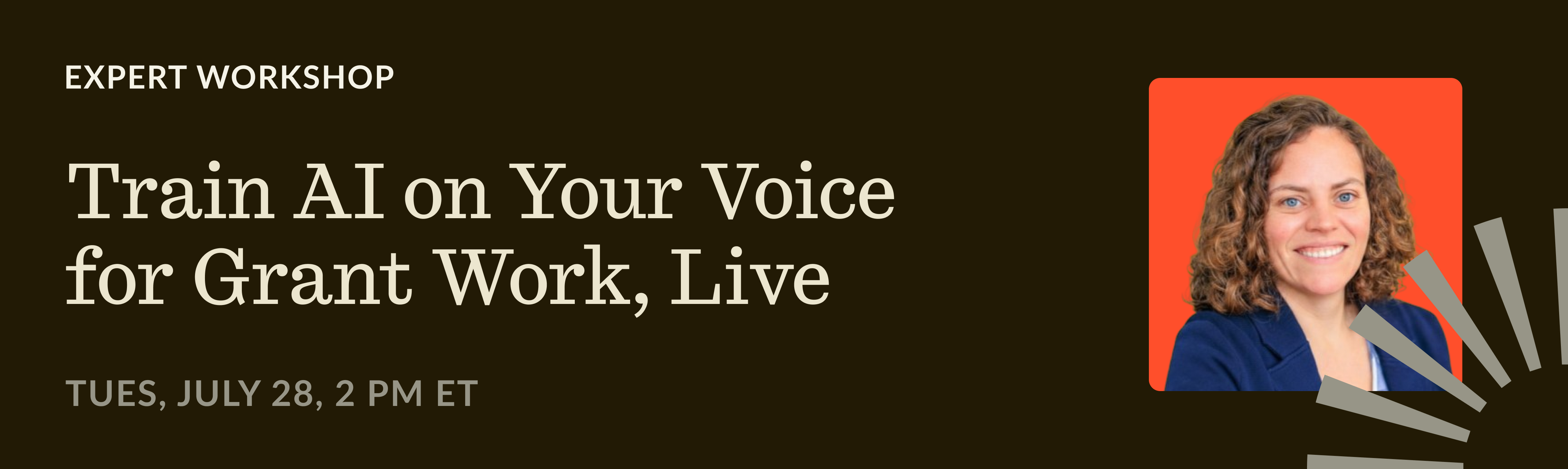
The #1 concern grant pros have about AI? Losing their organization's voice to generic output.
In this hands on workshop, you'll fix that live: build a voiceprint system that trains Claude or ChatGPT to write the way your team actually writes, and leave with it ready to use on your next grant.
On Tuesday, July 28th at 2pm ET, grants consultant Fielding Jezreel will join us to walk through the build.
You'll walk away with:
- A voiceprint document, built live, that trains Claude or ChatGPT to write in your organization's actual voice, plus a step by step handout to finish it
- The building blocks behind why AI drafts fall flat, and how to prompt so results hold up on your terms
- A smarter way to pair your new AI skills with a matching tool to surface best fit grant opportunities faster
Join us live for a chance to win free hours of AI grant consulting with Fielding.
Backed by new research from 176 grant professionals on how AI is actually showing up in their work.
👉 Save your spot now - it's free!
Pitfalls and Pointers
The strongest grant applications show how an organization’s program or initiative fits into something bigger. It sounds simple. But when you're deep in proposal mode and zeroed in on word counts and outcome metrics, it's easy to write as if your organization is the only one doing this work.
⚠️ Pitfall: Writing your application in isolation
When your proposal doesn't show how your work connects to the broader ecosystem, you're leaving funders to connect the dots themselves. Most won't.
- Vague partner references signal that collaboration is an afterthought, not a core part of how you operate.
- Proposals that focus only on what your organization will do with the grant funding miss the ripple effects that funders can find most compelling.
- Describing a single grant cycle's work without painting a picture of where it's headed long-term makes it harder for funders to see your organization as a long-term investment.
💡 Pointer: Position your organization as an integral part of an ecosystem (not an island)
Melissa Morazán shared three concrete strategies that consistently help grantees stand out, including examples of what each looks like in practice:
Name your partners. Funders want to see that your work is embedded in a community of organizations, not happening in isolation.
- ❌ "We collaborate with community organizations and local stakeholders to deliver our programs."
- ✅ "We partner with City Housing Authority, St. Mary's Health Clinic, and 3 other CBOs, with referrals from these partners making up 60% of our clients last year."
Highlight your multiplier effects. Funders want to see that their investment is a lever, not just a line item. How is their impact stretching beyond what your organization can do alone?
- ❌ "Our $50K request will fund a new case manager position to expand services."
- ✅ "This $50K leverages a $150K state match and will let our coalition reach 3 counties, representing a 4x expansion we couldn't do alone."
Paint a picture of where the work is headed long-term. Don't just describe what you'll do with the money, show funders how the work sustains itself and grows beyond the grant cycle.
- ❌ "Funding will support year-two implementation of our housing navigation program."
- ✅ "By year three, peer navigators will train other orgs to replicate the model — this grant seeds a regional network, not just one program."
Expert Perspectives
🏆 Melissa Morazán on Why Funders Want to See the Bigger Picture
Melissa Morazán, Vice President of Client Services and Operations at Pacific Foundation Services, who works alongside family foundations every day, spoke more extensively on the concept of leveraging multiplier effects to stand out:
"Highlighting your multiplier effects is another thing that funders love to see, to see the greater impact of grant funding. If you have any matching funds, any policy wins that you were a part of moving forward, any kind of work that you influenced, or collaborative programs…find a way to highlight those."
In practice, that looks like:
- Don't bury your matching funds in the budget. Lead with them in your narrative. Matching funds are proof that other funders have already vetted your work and said yes.
- When a partner organization is doing a warm handoff with your clients (e.g. taking them from your program into the next stage of support), name the partner, describe the handoff, and quantify it if you can. That's a multiplier funders want to see.
- If you're training other organizations in your model, say so explicitly. That's not just program impact, it’s sector-level influence, and it belongs in your application.
Open Grant Opportunities Spotlight
Clif Family Foundation Open Call
Grant Amount: $5,000 - $50,000
Next Deadline: August 1, 2026 | Next cycle: March 1, 2027
Who It's For: 501(c)(3) nonprofits with operating budgets under $8M working in food systems, environment, climate justice, or community health
The Details:
- Funder priorities include: Regenerative and Organic Farming, Food Production Workers’ Health and Safety, Climate Justice, Healthy Food Access, Inclusive Outdoor Access, and Keeping Indoors and Outdoors Safe from Pollution
- Prioritizes grassroots organizations with strong community ties operating at the local, state, or national level
- Supports general operating costs
What their past giving tells us:
- 31% of last year's awards went to new grantees — higher than their 3-year average of 24%
- Median award size of $20,000
- Highest priorities for past giving: Environment, Food & Agriculture, and Community Improvement & Capacity Building
Quality of Life Grants Program — Christopher & Dana Reeve Foundation
Grant Amount: $5,000 - $50,000 | Median Award: $20,000
Next Deadline: Fall cycle opens late August 2026 | Applications typically due early October.
Who It's For: 501(c)(3) nonprofits, municipalities, school districts, tribal entities, and community or veterans hospitals serving people living with paralysis
The Details:
- Grants support organizations serving people living with paralysis caused by spinal cord injuries, stroke, spina bifida, multiple sclerosis, cerebral palsy, ALS, and other conditions
- Five funding tiers ranging from open-focused project grants ($5,000-$24,999) to expanded impact grants (up to $100,000) for proven, evidence-based programs
- Special consideration given to organizations serving returning wounded military, cultural communities, rural residents, low-income populations, and newly injured people with paralysis
What their past giving tells us:
- 83% (!!) of awards in the last three years have gone to new grantees
- Median award size of $25,000
- Past projects funded include accessible playgrounds, adaptive sports programs, service animal programs, durable medical equipment, facility accessibility modifications, and arts programs
🔍 Track the fall cycle opening in August!
Ready to find more good-fit opportunities? 🔍 Explore thousands of other grant opportunities now!
Networking Nook
💻 Webinar: What Funders REALLY Want in Grant Performance Reporting ($29)
August 26, 2026 | 12:00 - 1:30 PM MT | The Grant Plant
Grant pros know reporting matters. But do you know what funders are actually looking for when they read your reports? And what common mistakes could be quietly hurting your renewal chances?
In this beginner to intermediate session, Tonia Brown, GPC, CGMS, Grant Compliance Manager at The Grant Plant, breaks down exactly what funders want to see and how to deliver it. You'll walk away knowing how to:
- Read funder language to tailor your reports more effectively
- Avoid the most common reporting mistakes
- Highlight your impact in ways that actually resonate with funders
- Strengthen funder relationships that lead to future funding opportunities
Ready to stop guessing which funders are right for your organization?
Instrumentl surfaces 10- years of funder context with open grants, up-to-date giving history, past grantees, geographic focus, so you can show up to every application knowing your organization belongs in their portfolio.
Sign up to get The Impact newsletter delivered to your inbox every week. Subscribe now!
100% Free Grant Writing Resources Straight to Your Inbox
