

Grant writing is time consuming - no doubt about it. Between wrestling with word counts, drafting and revising narratives, tailoring language for different funders, and tightening stories to fit strict guidelines, even the most experienced grant professionals often feel stretched thin.
Here’s the good news: AI is starting to change that.
Our goal in this guide is to provide a comprehensive look into AI grant writing: what it is, where it adds value, and how it’s being used by grant professionals today. We’re also going to share:
- Steps for using AI thoughtfully to save time without compromising quality or funder trust
- What the future of AI grant writing looks like
- 20 AI grant writing prompts to get you started
Ready to learn how to lighten your workload? Let’s get into it!
What Is AI Grant Writing?
AI grant writing refers to the use of artificial intelligence (AI) tools to support parts of the grant writing process, such as researching funders, drafting proposal sections, editing language, and checking for consistency.
It’s important to be clear about what AI isn’t. AI doesn’t replace grant writers, relationship-building, or strategic thinking. Instead, it helps handle time-consuming tasks so grant professionals can focus on alignment, storytelling, and impact.
When used thoughtfully, AI-powered grant writing can help nonprofits work more efficiently, reduce burnout, and increase their chances of securing funding, ultimately allowing teams to spend more time advancing their missions and programs.
Current State of AI in Grant Writing
From drafting narratives to reviewing funder guidelines, AI is increasingly shaping how grant professionals work.
Data from Instrumentl’s AI in Grant Writing survey report shows that nonprofits are using AI in focused, practical ways—primarily to save time and reduce manual effort.
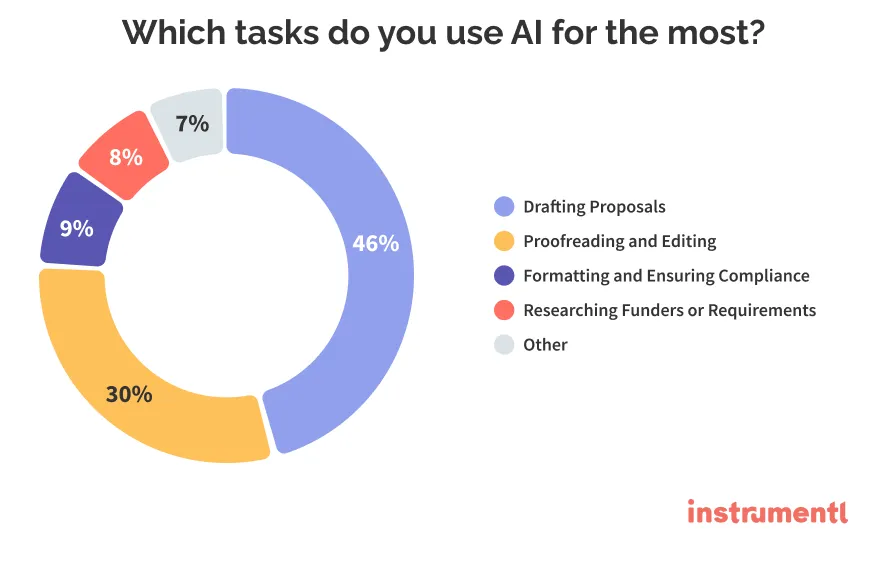
Many organizations reported that AI helps them move through early drafting stages significantly faster, making it easier to pursue more opportunities without increasing staff workload.
But as with any new technology, there is still some uncertainty regarding the efficacy of AI grant writing.
As grant expert Meredith Noble explains in Using AI to Write Grants: What to Know in 2025, much of the hesitation around AI comes from misplaced expectations. AI can help speed up early drafts and improve clarity, but it can’t replace strategic thinking, funder knowledge, or relationship-building.
The bottom line is that the most effective grant professionals use AI as a writing and research assistant, not a decision-maker or strategist.
How AI Can Help You Overcome Common Challenges in Grant Writing
Grant writing is time-intensive by nature, which is why many nonprofits are exploring grant writing with AI as a way to increase capacity without increasing staff workload. When used thoughtfully, AI can help address several of these challenges without sacrificing quality or compliance.
Speed: Drafting Proposals More Efficiently
One of the most immediate benefits of AI is speed. AI tools can help grant professionals move from a blank page to a solid first draft much faster, often reducing drafting time by up to 50%.
Grant teams are using AI to:
- Generate first drafts of common proposal sections
- Rework existing language for new applications
- Summarize long prompts or RFP requirements
As grant expert Matt Hugg explains:
“There’s a saying that a writer’s biggest fear is a blank page. AI can be a big help in giving you a starting point - but by no means is it an ending point…Let AI give you something to work with, but never any final copy.”
Quality: Improving Consistency and Adherence to Best Practices
AI can also support proposal quality by helping maintain consistency across applications, especially for organizations submitting multiple grants at once.
AI can help:
- Standardize language across narratives
- Ensure core messaging and outcomes are clearly stated
- Reinforce common grant-writing best practices
For many grant writers, that consistency also shows up in how proposals sound. As founder and grant professional Beth Brandon Jensen puts it:
“I feel like AI makes me a stronger writer. It also helps me pinpoint some of those moments where it’s like, yeah, this is really heavily over-fluffy language - and I don’t like how this is looking, so we’re going to refine it.”
Research: Supporting Funder Analysis and Fit
Funder research is another area where AI can save meaningful time. Reviewing funder guidelines, past awards, and alignment criteria can be labor-intensive, particularly when teams are stretched thin.
AI can support this work by:
- Summarizing funder priorities and requirements
- Surfacing potential alignment between programs and funder goals
- Identifying common themes across funding opportunities
As Margit Brazda Poirer, MS, GPC, founder of Grants4Good, notes, AI’s value extends beyond drafting when used intentionally. She encourages grant professionals to use AI as a thought partner, from preparing prospect outreach to stress-testing alignment and even practicing how to talk about their work with funders.
“You can start to build and practice conversing with funders and potential donors. This is one of the uses people don’t often think about…you can consider it a training tool.”
AI doesn’t replace strategic decision-making, but it can help teams reach clearer, more informed decisions faster.
Types of AI Grant Writing Tools
When it comes to types of AI grant writing tools, there’s an important distinction to be made: some AI tools are built specifically for grant writing, while others are more general tools that can be used or adapted for grant writing.
For example, tools like ChatGPT, Claude, and Grammarly—while not necessarily built for the grants process—can still help with drafting narratives, enhancing readability, and editing for clarity and tone.
With that said, these more generic tools require more training and context to deliver worthwhile results.
Alternatively, there are grantwriting-specific AI tools that are purposefully designed and developed to streamline the grant writing process. Examples include:
Because these tools are grant-focused, they need less prompting and offer more guardrails around alignment and best practices.
For a detailed comparison of specific tools, including strengths, limitations, and best-fit use cases, check out the Best AI Tools for Grant Writing in 2025.
Where AI Becomes Most Useful: Unifying Workflows
Many AI tools can support the actual proposal development step of the grant writing process, but the biggest gains come from when the entire grant lifecycle is connected and unified in one platform.
This is where Instrumentl adds value. Instrumentl is the first intelligent, full lifecycle grant platform that empowers nonprofits to discover, apply for, and manage grants all in one place.
Here’s a quick overview of our AI-powered tools:
- Prospecting Assistant: A new onboarding experience that uses agenic chat-style flow to guide users through project setup and then delivers higher-quality grant matches using AI semantic matching.
- Apply: AI assistance that helps you draft winning proposals 40% faster while maintaining your unique voice by resurfaces relevant content from your past proposals to use in new applications. (See how this workflow looks in practice by watching AI-Powered Grant Writing for Nonprofits.)
- Apply Advisor: An AI-powered side panel that serves as your ever-present thought partner, reviews drafts, and suggests improvements. Apply Advisor delivers targeted funder insights using Instrumentl's comprehensive 990 and grant data, provides strategic answer revisions, and features search capabilities to locate content from previous applications.
- Award Assistant: An AI-powered tool that automatically extracts key information from all your grant documents, saves the info and tasks to Instrumentl, and creates a shareable summary.
Together, these tools help grant professionals move from research to first draft to final report more efficiently—while keeping strategy, compliance, and human judgement at the center of the process.
Step-by-Step: Using AI for Grant Writing
Even if your organization isn’t ready to invest in a dedicated AI grant writing tool, there are still ways you can leverage more generic chatbots like ChatGPT to help speed up the proposal process:
1. Pre-Writing: Research and Outlining
Before writing begins, AI can help you get organized and focused.
Ask AI to:
- Summarize funder guidelines and eligibility criteria
- Highlight key priorities, themes, and scoring requirements
- Generate outlines aligned with funder expectations
2. Drafting: Using Effective Prompts
With an outline in place, AI can help generate first drafts when given clear direction.
Make sure you provide strong prompts that include things like:
- Background on your organization and program
- Word count or length guidance
- The specific goal of each section (e.g., needs statement, outcomes, sustainability)
- Past proposals to pull language from
3. Editing: Refining AI Output
AI-generated drafts should always be reviewed and refined by a human to ensure quality and accuracy.
After reviewing the draft, you can ask the AI to:
- Clarify language and reduce jargon
- Improve flow and readability
- Adjust tone to better match funder expectations
4. Compliance: Checking Requirements and Details
Before submission, AI can support final checks - though it should not replace careful human review!
At this stage, AI can:
- Help confirm word limits and formatting requirements
- Help verify that all required sections are included
- Flag any inconsistencies or missing information
Security and Trust in AI Grant Writing
As AI becomes more common in the grant space, questions around security, data privacy, and trust are increasingly important—especially for nonprofits working with sensitive organizational and financial information.
Data Privacy and Responsible Use
Not all AI tools are built with nonprofit needs in mind. Some public, general-purpose tools may store or reuse submitted information in ways that aren’t appropriate for confidential grant materials.
To use AI responsibly, nonprofits should:
- Avoid uploading sensitive or confidential documents into unsecured tools
- Understand how AI platforms store and use submitted data
- Establish internal guidelines for when and how AI can be used. This Internal Governance Policy can serve as an example
Accuracy, Compliance, and Human Oversight
AI-generated content should always be reviewed by a human before submission. Even well-written output can include inaccuracies, outdated information, or misinterpretations of funder requirements.
Maintaining trust with funders means:
- Verifying all facts, numbers, and claims
- Ensuring alignment with funder guidelines and compliance rules
- Using AI as a support - not a substitute - for professional judgement
Choosing AI Tools You Can Trust
When evaluating AI grant writing tools, look for platforms that prioritize:
- Clear data privacy and security practices
- Transparency around how AI is used
- Features designed specifically for nonprofit and grant workflows
Trustworthy AI tools help teams work more efficiently without compromising credibility or funder relationships.
Future of AI Grant Writing
AI will continue to evolve, but its role in grant writing is becoming clearer. Rather than replacing grant professionals, future tools are likely to deepen support across the grant lifecycle, helping teams work more efficiently while keeping human judgement at the center.
Even as these tools improve, the fundamentals of successful grant writing won’t change. Strong proposals will continue to depend on:
- Clear program design and measurable outcomes
- Accurate data and honest storytelling
- Strong funder relationships built on trust
The most effective grant teams will be those that use AI intentionally - leveraging speed and efficiency while preserving the human insight that funders value.
20 AI Grant Writing Prompts (Downloadable!)
Knowing how to prompt AI makes a huge difference in the quality of the content it produces. Well-written prompts give AI the context it needs to generate clearer drafts, surface relevant insights, and reduce time spent revising.
To help grant professionals get started, we’ve created a free downloadable set of 20 practical AI prompts designed specifically for grant writing—covering research, drafting, editing, and review.
Download the full list: AI Grant Writing - 20 ChatGPT Prompts You Can Use
Below are a few examples from the guide to show how these prompts can be used in real workflows.
Example AI Grant Writing Prompts
- Funder Alignment
“Review this funder’s stated priorities and summarize how our program aligns with their funding goals.”
- Needs Statement Drafting
“Using the following community data and program context, draft a clear and compelling needs statement.”
- Program Description
“Create a draft program narrative that explains activities, target population, and expected outcomes.”
- Editing for Clarity
“Revise this paragraph to improve clarity, remove jargon, and better highlight impact.”
- Compliance Check
“Review this draft and flag any areas that may not fully address the funder’s requirements or scoring criteria.”
These prompts are meant to be adapted and refined based on your organization, the funder, and the specific proposal. Remember - AI works best when it is given clear direction and context.
Wrapping Up: Use AI With Intention
As we’ve covered, nonprofits are using AI to streamline and speed up their grant workflows. When paired with clear prompts and keen human oversight, AI helps reduce repetitive work and creates more space (and time!) for strategic thinking.
What hasn’t changed is what makes grant writing successful. Strong proposals still depend on accurate data, clear storytelling, and compliance with funder requirements. Trust and relationships remain at the center—and AI works best when it supports those fundamentals, not when it tries to replace them.
For grant professionals, the goal isn’t to adopt every new tool. It’s to use AI where it adds real value, sets clear guardrails, and keeps human judgement at the center of the process. Don’t forget to try out Instrumentl’s own AI grant writing tool free for 14 days to see just how much time it can save you.

